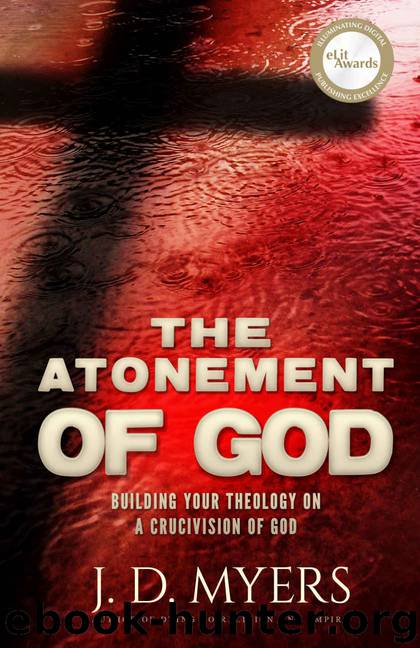
The Atonement of God: Building Your Theology on a Crucivision of God by Myers J. D
Author:Myers, J. D.
Language: eng
Format: epub
Tags: Atonement, Penal Substitution, crucifixion, Christus Victor, Non-violent atonement, Jeremy Myers, JD Myers, Ransom to Satan, death of Jesus, sacrifice, forgiveness
ISBN: 9781939992444
Publisher: Redeeming Press
Published: 2016-03-21T04:00:00+00:00
Chapter 10
Reveals the Truth about Justice
Despite all the teaching about forgiveness from Jesus and the cry of forgiveness that Jesus uttered from the cross, we often get the impression that God did not want to forgive people for their numerous sins against Him, but was persuaded or convinced to do so by Jesus. This is especially true when the cross of Jesus is viewed through the lens of retributive justice and the Penal Substitution view of the atonement. Deep in the heart of humanity is the feeling that God is angry with us about our sin and that God demands sacrifice to satisfy His anger. We interpret the cross of Jesus as the event where God demanded the blood of a perfect sacrifice to satisfy or placate His wrath toward sin. The way it is sometimes presented at a popular level, God was so angry about sin, He demanded death as a means to satisfy His wrath. But He also loved us, and so while justice demanded that He kill us all for our sin, He sought other methods of appeasement. Initially He required the blood of bulls and goats, though He knew that this was not a permanent solution. Instead, these sacrifices only looked forward to the death of His Son, Jesus, upon whom He poured His wrath so that it would not fall upon us. As a result of this narrative, some people have an impression of God as being so angry about sin, that He just had to kill somebody, and rather than take out His anger on all of us, He killed Jesus instead. God required payment for forgiveness, and took temporary payments from the blood of bulls and goats until He was able to receive full payment through the blood of Jesus, at which point He was able to finally extend forgiveness of sins.
We have already seen in previous sections of this book that God was not angry at humanity for our sin and did not demand sacrifice as a way of getting payment for our sin, and so the truth about forgiveness is now easier to see: God did not need or want to kill anyone or anything in order to extend forgiveness. Both types of forgiveness are freely extended by God without payment of any kind. Though aphesis does often have conditions, the achievement of these conditions do nothing to please or appease God, but simply help us avoid the dire consequences of our own sin.
This truth about the freedom of forgiveness is seen more clearly when we think about the price of forgiveness. Forgiveness, by definition, does not require payment. If your neighbor has wronged you and you eventually decide to forgive him, do you first need to make him pay for what he has done? Of course not! You can just forgive him. If you ask for restitution and receive it, then you are not forgiving him, but are getting paid to not retaliate in kind, which is not forgiveness at all.
Download
This site does not store any files on its server. We only index and link to content provided by other sites. Please contact the content providers to delete copyright contents if any and email us, we'll remove relevant links or contents immediately.
The Secret Power of Speaking God's Word by Joyce Meyer(3161)
Signature in the Cell: DNA and the Evidence for Intelligent Design by Stephen C. Meyer(3123)
Real Sex by Lauren F. Winner(3005)
The Holy Spirit by Billy Graham(2938)
The Gnostic Gospels by Pagels Elaine(2517)
Jesus by Paul Johnson(2349)
Devil, The by Almond Philip C(2324)
23:27 by H. L. Roberts(2245)
The Nativity by Geza Vermes(2224)
Chosen by God by R. C. Sproul(2158)
All Things New by John Eldredge(2155)
Angels of God: The Bible, the Church and the Heavenly Hosts by Mike Aquilina(1951)
The Return of the Gods by Erich von Daniken(1925)
Angels by Billy Graham(1917)
Knowing God by J.I. Packer(1848)
Jesus of Nazareth by Joseph Ratzinger(1802)
The Gnostic Gospel of St. Thomas by Tau Malachi(1781)
How To Be Born Again by Billy Graham(1775)
Evidence of the Afterlife by Jeffrey Long(1774)
